Welcome!

Legacy Equine Hospital is a fully equipped equine medical and surgical facility located just south of Tulsa, OK at the intersection of Highway 75 and 171st Street. Our friendly and highly trained staff are able to handle everything from annual wellness appointments to advanced soft tissue and orthopedic surgery. We also provide 24/7 emergency care. Please visit our website at legacyequine.com or call us at 918-827-7300 for more information.

Tuesday, September 16, 2014

TUESDAY TRIVIA ANSWER

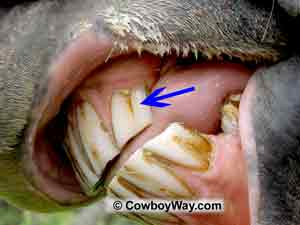
This marking is called Galvayne's Grove and is found on the two lateral upper incisor teeth.  This is commonly used to age horses because it appears and disappears at certain ages.  It will start to appear at about 10 years old, be halfway down the tooth at 15, and go all the way down around 20 years old.  It's important to remember that these are just averages and some horses don't read the book, so always take the groove with a grain of salt :)


http://www.71ranch.com/images/galvayne01.gif

Check back next Tuesday for another dental trivia question.  We will be giving away a special prize for someone who gets the right answer!

TUESDAY TRIVIA


Here's your question for the week!

What is the line on this horse's tooth called (arrow is pointing to it) and when do we expect to see it?

Answer will be posted at the end of the day!

Monday, September 15, 2014

NEW TREATMENTS AVAILABLE

Happy Monday Everyone!


We wanted to use today's post to highlight two treatment options for osteoarthritis and soft tissue injuries that are now available at Legacy Equine.  Both of these options are processed in our on-site laboratory and are made using your horse's own blood cells.  This means that there is lower risk of reactions to these products.

ACP (Autologous Condition Plasma)

http://cdn2.arthrex.com/taxon-images/acp/acp_0-large.png


Similar to products marketed at 'Platelet Rich Plasma', this double-syringe device developed by Arthrex Systems concentrates the healing powers of platelets into a small volume of plasma.  Platelets are blood cells normally found moving through the body that help form clots and heal sites of damage.  By concentrating the platelets and injecting them into a damaged tendon we can cause the platelets to release growth factors, which can induce a healing response in that area.  An advantage to the ACP system over traditional platelet rich plasma is the ease of processing.  This system only requires 15mL of blood to produce one treatment dose and the product can be ready in about 30 minutes.  ACP has had the most proven success when used in soft tissue injuries, such as tendons and ligaments.  Other potential uses include osteoarthritis, stifle damage, and used topically on chronic non-healing wounds. 


IRAP II (Interleukin-1 Receptor Antagonist Protein)


Also manufactured by Arthrex, this system was developed to manage the pain and discomfort associated with osteoarthritis and help slow the progression of cartilage destruction.  To produce this product roughly 50mL of your horse's blood is placed into a conical tube and incubated with special coated glass beads for 18-24 hours.  The coating on the beads triggers certain blood cells, called monocytes, to produce the IRAP proteins.  These specialized proteins bind to receptors within the joint and block the action of Interleukin-1, which is the major inciting factor for joint inflammation and pain.  Although it can take a full 24 hours to process this product, we will normally harvest multiple doses from one collection.  These additional doses can be frozen and used up to a year later.


If you have any other questions about these products feel free to post in the comments or email us at legacyequinehospital@gmail.com.

If you have a horse that you think may be a good candidate for one of these therapies please call us at 918-827-7300 to schedule an appointment.

Friday, September 12, 2014

IT'S THE WEEKEND!

Happy Friday Everyone!

Even though it may be dreary outside today the weekend ahead looks beautiful so get out there and enjoy it!  As always we will be here for you Saturday and Sunday should any emergencies arise; you can always reach us at 918-827-7300.


Tuesday, September 9, 2014

TUESDAY TRIVIA- ANSWER

Did everyone figure it out?  Here's the answer:

Your average adult horse (>5yrs) can have anywhere from 36 to 44 teeth.  Mares will most often have 36 teeth, while geldings and stallions can vary between 40 and 44 teeth.  A horse's mouth is broken up into 4 separate sections known as arcades.  Each arcade is made up of 3 Incisors, 1 Canine (sometimes), 3 or 4 Premolars, and 3 Molars.  Here are a few diagrams for you to reference:


http://www.equmed.com/images/teeth%20copy.jpg      http://www.ckequinehospital.com/content_th_big/PAGE175_Modified_Triadan_System_Diagram.jpg

Canine teeth are normally only found in male horses but can be found in some mares.  The first Premolar is referred to as a 'Wolf Tooth' and is a vestigial tooth, meaning that horses today have no use for it.  It is normally only present in male horses and they are usually only found in the upper jaw.  However... wolf teeth can be present in some mares, absent in some male horses, and found in both the upper and lower jaws.  These teeth are routinely removed as they can cause problems when training a horse to a bit.  

If you have any other questions about this topic please feel free to post them to the comments or email us at legacyequinehospital.com

TUESDAY TRIVIA

It's time for our first edition of Tuesday Trivia!  We will post questions here every Tuesday morning and will post the answer at the end of the day.  Some Tuesday Trivia questions will be contests to win free services and merchandise from Legacy so be sure to subscribe to the blog for updates!

In honor of our dental special going on right now (see post below for more information), September's questions will focus on teeth and oral health.

http://d2tq98mqfjyz2l.cloudfront.net/image_cache/1384556356609266.jpg

So here's you question!

How many teeth does a horse have?

The answer will be posted at 5pm today so make sure to check back and see if you were right!

Monday, September 8, 2014

CASE OF THE MONTH- JULY

Happy Monday Everyone!

We'd like to get this week started by highlighting our 'Case of the Month' series from our Facebook page.  This was a case we saw in the hospital back in July and it highlights how serious puncture wounds to the foot can be.  If you have any questions regarding this case you can post them here or email us at legacyequinehospital@gmail.com.  You can also view the information on our Facebook page by clicking here.

July Case of the Month

This QH gelding presented to our clinic 5/5 (non weight bearing) five days after the owner found a D-cell battery in poking into the sole of his left front foot. The owner removed the foreign object and placed the gelding on antibiotics and administered a Tetanus Toxoid vaccine and an anti-inflammatory. His condition continued to worsen which is why the owner brought him to us. During the examination, hoof testers were applied to check for the presence of an abscess, which was absent. A skin scrub was applied so that a local nerve block could be performed. Once the nerve block was performed, radiographs were taken of the foot to ensure there was no remaining foreign material left in the foot. After radiographs, a sterile scrub was performed for a coffin joint tap to check infection. Joint fluid filled the syringe spontaneously (indicating an increased amount of fluid) and the fluid was thick, cloudy and discolored indicative of infection. Normal joint fluid should be clear, light straw colored and the consistency of warm honey. A laboratory joint analysis was performed on the joint fluid which revealed a very high increase of white blood cells, protein and bacteria. A joint lavage was performed and a one liter bag of saline was flushed through the entire coffin joint. Once the joint lavage was finished, a concentrated dose of antibiotics was placed in the joint and a bandage applied over the injection sites to keep them clean. Regional perfusion was then performed on the left front leg to help deliver concentrated antibiotics to the distal limb. This regimen was continued for three days along with the horse being on oral antibiotics and anti-inflammatories. Due to financial constraint, the owner took the horse home and continued him on oral antibiotics and anti-inflammatories. Several days later, we called the owner to check on the gelding's progress and the owner stated that he was not doing well and would likely put him down the following day.

It is extremely important to know whenever you find a foreign object in your horses foot, DO NOT REMOVE IT! Call your veterinarian immediately so they can examine your horse and determine the proper course of treatment. By removing the foreign object, the doctor will have no way of knowing whether or not the object punctured something vital in the hoof.

CAUTION: THESE PHOTOS MAY CONTAIN GRAPHIC MATERIAL AND MAY NOT BE SUITABLE FOR YOUNGER AUDIENCES